 LNEYA Industrial Chillers Manufacturer Supplier


Semiconductor Chiller vs. Industrial Chiller: What’s the Difference
People often ask if a semiconductor chiller is just another type of industrial chiller. At first glance, they look similar. Both move heat away from equipment and keep processes stable. But once you start working with wafer testing or precision optics, you quickly realize that a standard industrial chiller just can’t keep up.
Let’s look at what separates a semiconductor chiller from a regular industrial one and how to choose the right system for your job.
What Is a Semiconductor Chiller
A semiconductor chiller is designed for one thing, extreme temperature precision.
In semiconductor manufacturing, small temperature swings can destroy yield. When you’re working with wafer etching, lithography, or laser alignment, even a tenth of a degree matters.
A semiconductor chiller keeps the coolant temperature steady, often within ±0.1°C or tighter. It constantly measures flow rate, pressure, and temperature, and adjusts through a PID or PLC control loop. The goal is to eliminate temperature drift that could affect chip performance or optical alignment.
Unlike a basic process chiller that might cool a mold or a tank, this kind of system has to be intelligent. It talks to the equipment it is cooling, responding instantly to load changes. You’ll often see them in wafer fabs, testing labs, or cleanroom environments where every detail counts.
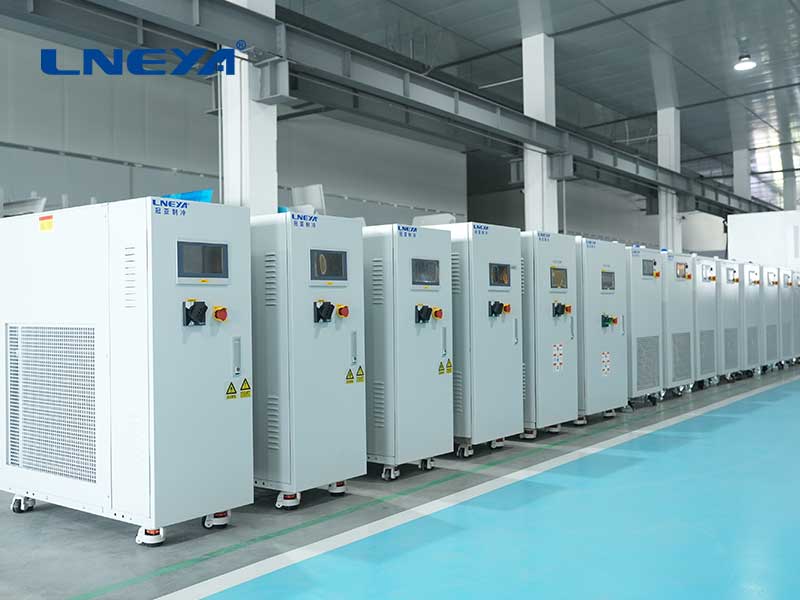
Key Differences Between Semiconductor and Industrial Chillers
Even though both systems use compressors, heat exchangers, and pumps, their priorities are completely different. An industrial chiller focuses on capacity and reliability. It is built to run hard and tolerate wide temperature ranges. A semiconductor chiller on the other hand is all about precision and stability. It is a specialist tool rather than a general purpose cooler.
Temperature Accuracy
Temperature control is the heart of the difference.
An industrial chiller might swing one degrees without affecting its process. That is fine for plastic molding or plating lines. But in semiconductor work, even a 0.2°C shift can throw off a lithography alignment or cause an uneven etch.
A semiconductor chiller uses fine tuned sensors and advanced control algorithms to hold a stable setpoint. When a heat load changes suddenly, it reacts almost instantly, with compressor speed, expansion valve position, and heater output all adjusting in sync.
Coolant Type
Industrial chillers usually circulate tap water or glycol mixtures. Semiconductor chillers use deionized water or special thermal fluids that will not leave residues or ions. These liquids have to be ultra clean to prevent electrical leakage or contamination inside delicate semiconductor tools.
The entire loop is sealed and filtered to keep out particles and oxygen, and all wetted parts are made from stainless steel or PFA to avoid corrosion.
This clean, closed loop design also prevents the coolant from affecting vacuum chambers or optical components. It is not just cooling, it is protecting the process.
Cleanliness
Semiconductor chillers operate in cleanroom environments, so cleanliness is built into the design. The internal plumbing, fittings, and tanks are polished to avoid micro particles. The system often includes inline filters and degassers that remove bubbles and trace contaminants.
Industrial chillers do not need this level of care. They sit on factory floors, near dust, oil, and sometimes open tanks. Their job is to keep machines from overheating, not to maintain chemical purity.
Response Speed
In semiconductor tools, thermal loads can change in seconds. Lasers turn on and off, heaters ramp quickly, and test heads move fast. A semiconductor chiller has to respond in real time. It balances refrigeration and heating power so that outlet temperature barely moves even when the process changes suddenly.
An industrial chiller responds more slowly. For most industrial uses, that is fine. But for a wafer tester running 24/7, those spikes are unacceptable.
Application
Industrial chillers are found in factories that make plastics, chemicals, food, and packaging. They cool molds, reactors, plating baths, and even HVAC systems.
Their main goal is to remove heat efficiently. As long as the outlet temperature is within a few degrees, everything works.
Semiconductor chillers live in a completely different world. They support lithography machines, ion implanters, laser systems, and IC testers. Every one of those tools needs precise temperature stability to maintain calibration and repeatability.
Cost
Because of all these design differences, semiconductor chillers are naturally more expensive. They use corrosion resistant materials, high accuracy sensors, advanced control systems, and often have built in communication interfaces like Ethernet or RS485.
But cost should be viewed in context. In semiconductor production, one batch of defective wafers can cost more than the chiller itself. So paying for precision is really an investment in yield and reliability.
Industrial chillers are more affordable and easier to maintain. Parts are standard, and the systems tolerate a wide range of water quality. For general manufacturing, they offer excellent value.
Choosing the Right System for Your Application
If your process involves wafer processing, photonics, or laser cooling, a semiconductor chiller is almost always the right choice. It gives you temperature precision, stability, and cleanliness that general chillers simply cannot match.
When your goal is to cool molds, tanks, or process water in a factory, an industrial chiller will do the job at a much lower cost.
In many facilities, both systems work side by side, with industrial chillers for general plant cooling and semiconductor chillers for precision tools.
Explore LNEYA Chiller Solutions
LNEYA engineers design chillers with different performance according to your application. You can find the equipment that perfectly matches your working conditions here. Contact us now to start technical and product consultation.

Recent Blogs
- Chiller Components and Refrigeration Fundamentals Guides
- Chiller Types and Selection Guides
- How Does a Peltier Cooler Work
- Peltier Chiller vs. Compressor Chiller
- What Is a Peltier Chiller
- OEM vs Aftermarket Chiller Spare Parts
- Chiller Surge
- Chiller Cooling Capacity Units
Catalog
- December 2025
- November 2025
- October 2025
- September 2025
- August 2025
- July 2025
- June 2025
- May 2025
- March 2025
- February 2025
- January 2025
- December 2024
- November 2024
- October 2024
- September 2024
- August 2024
- July 2024
- June 2024
- May 2024
- April 2024
- March 2024
- February 2024
- September 2023
- July 2023
- June 2023
- May 2023
- January 2023
Tag
air cooled chiller chiller Chiller Installation Chiller Maintenance chiller refrigerant chillers Cold Assembly Freezer cooling chiller cooling heating system cooling system dynamic temperature control system energy efficient chiller explosion-proof chiller freezer heating circulator industrial chiller industrial chillers industrial cooling industrial freezer industrial refrigerator jacket reactor laboratory chiller low temperature chiller news oil chiller process chiller process cooling reactor chiller reactor cooling reactor cooling heating reactor heating cooling refrigerated circulator screw chiller semiconductor chiller semiconductor test chiller sundi tcu temperature control test chamber thermostat ultra low temperature chiller vehicle test chiller water chiller water cooled chiller
Contact Us
Related Chillers


CONTACT US
TEL:
EMAIL:
WeChat & WhatsApp:

Wechat QR

Have a question or need a quote? Fill out the form below, and our team will get back to you within 24 hours.

