 LNEYA Industrial Chillers Manufacturer Supplier


Can One Chiller Cool Multiple Machines
In many factories and labs, multiple machines generate heat, but space and budget often allow only one chiller. This raises a common question: can one industrial chiller handle multiple machines without compromising performance or stability?

How One Industrial Chiller Usually Works
A typical industrial chiller cools a single loop of water or glycol. The fluid absorbs heat from the equipment and returns it to the chiller, where it is cooled again before circulating back.
How to Cool Multiple Machines With One Chiller
Connecting several machines to a single chiller is possible if the total cooling capacity matches the combined heat load. The chiller acts as a central source, circulating chilled fluid through branch lines or manifolds to each machine.
Flow control valves help adjust cooling for individual devices, and return lines bring warmed fluid back to the chiller. Success depends on balancing flow rates and maintaining temperature stability for all connected machines.
Advantages of Cooling Multiple Machines With One Chiller
Lower Cost
Using one industrial chiller instead of multiple smaller units reduces upfront investment. You avoid buying multiple compressors, pumps, and control panels. It also simplifies installation.
Simpler Maintenance
Maintaining one system is easier than servicing several independent chillers. Fewer components mean fewer points of failure, and technicians can focus on a single temperature control system.
Better Space Utilization
A single chiller takes up less floor space than multiple units. For compact production areas, this can free up valuable room for additional machines or workflow improvements.
Higher Energy Efficiency
Large chillers often operate more efficiently at steady loads than multiple smaller chillers running intermittently. Properly balanced flow and load distribution also reduce energy waste, helping the system stay economical over time.
Potential Risks of Cooling Multiple Machines with One Chiller
Different Temperature Requirements
Machines may need different cooling temperatures. A single-loop chiller may struggle to maintain all devices at their required setpoints, causing some machines to overheat or underperform.
Temperature Fluctuations from Load Changes
If one machine suddenly draws more cooling, it can affect the flow to other devices. This leads to temperature swings that may impact product quality or process stability.
Mismatch Between Total Load and Chiller Capacity
If the combined heat load exceeds the chiller’s design, the system cannot maintain set temperatures. Overloading the chiller can shorten its lifespan and increase energy consumption.
Maintenance Downtime Risk
If the single chiller goes offline for maintenance or repair, all connected machines lose cooling. This can halt production and create additional risks, especially in precision processes.
Multi-Channel Chiller: The Smarter Way to Share Cooling

What Is a Multi-Channel Chiller
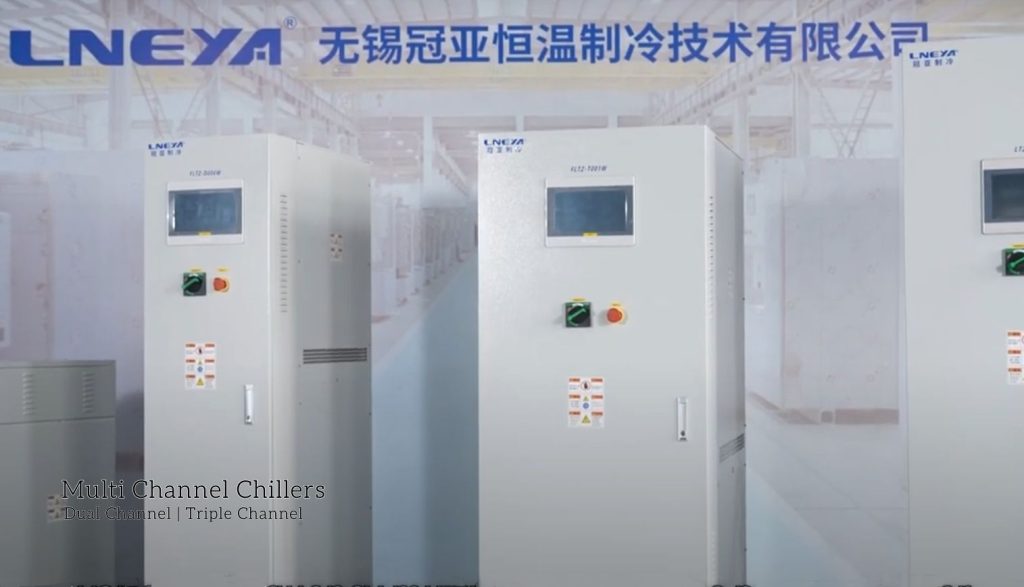
A multi-channel chiller integrates multiple independent cooling circuits into a single unit. Each channel has its own pump, compressor, and temperature control. This design allows one system to serve multiple machines with different temperature requirements.
You get independent cooling channels without installing several separate chillers, simplifying installation and control while maintaining precision.
Key Benefits of Multi-Channel Cooling
Multi-channel chillers eliminate the common problems of a single-loop system. Each machine or group of machines gets its own controlled flow, preventing interference. If one channel experiences a spike in load, it does not affect the others.
Temperature stability improves across the board, and operators can monitor all circuits from a single interface. Multi-loop design also reduces piping complexity and makes maintenance more predictable.
• Precise Temperature Control for Each Machine
Every channel can maintain its setpoint independently, which is critical for sensitive processes such as laser cutting, chemical reactions, or semiconductor production.
• Enhanced Process Stability
Machines operate consistently even when other equipment has fluctuating loads. This improves quality and reduces scrap or rework.
• Space and Cost Efficiency
Instead of installing several chillers, a multi-channel unit consolidates multiple cooling circuits into one compact system. This reduces footprint and overall investment.
• Energy Efficiency
Independent channels allow the system to run only the circuits needed at any given time, lowering power consumption and operational costs.
• Simplified Maintenance
One unit with centralized monitoring and control is easier to service than several separate chillers. Alerts, flow readings, and temperature data are all available from a single interface.
Get your multi-channel chiller solution
If you are looking for a cooling system that can provide precise temperature control for multiple equipment and processes at the same time, LNEYA recommends multi-channel chillers. Contact us for more information or to get a detailed quote.

Recent Blogs
- Chiller Components and Refrigeration Fundamentals Guides
- Chiller Types and Selection Guides
- How Does a Peltier Cooler Work
- Peltier Chiller vs. Compressor Chiller
- What Is a Peltier Chiller
- OEM vs Aftermarket Chiller Spare Parts
- Chiller Surge
- Chiller Cooling Capacity Units
Catalog
- December 2025
- November 2025
- October 2025
- September 2025
- August 2025
- July 2025
- June 2025
- May 2025
- March 2025
- February 2025
- January 2025
- December 2024
- November 2024
- October 2024
- September 2024
- August 2024
- July 2024
- June 2024
- May 2024
- April 2024
- March 2024
- February 2024
- September 2023
- July 2023
- June 2023
- May 2023
- January 2023
Tag
air cooled chiller chiller Chiller Installation Chiller Maintenance chiller refrigerant chillers Cold Assembly Freezer cooling chiller cooling heating system cooling system dynamic temperature control system energy efficient chiller explosion-proof chiller freezer heating circulator industrial chiller industrial chillers industrial cooling industrial freezer industrial refrigerator jacket reactor laboratory chiller low temperature chiller news oil chiller process chiller process cooling reactor chiller reactor cooling reactor cooling heating reactor heating cooling refrigerated circulator screw chiller semiconductor chiller semiconductor test chiller sundi tcu temperature control test chamber thermostat ultra low temperature chiller vehicle test chiller water chiller water cooled chiller
Contact Us
Related Chillers

CONTACT US
TEL:
EMAIL:
WeChat & WhatsApp:

Wechat QR

Have a question or need a quote? Fill out the form below, and our team will get back to you within 24 hours.

