 LNEYA Industrial Chillers Manufacturer Supplier


Common Chiller Specifications You Should Know
Spec sheets of chillers are not just paperwork. They affect uptime, energy bills, and product quality. In this piece I walk through the key chiller specifications you will see on a data sheet. I explain what each one means and why it matters in the field.

Cooling capacity
Cooling capacity tells you how much heat the chiller can remove. It usually shows up in kilowatts or tons of refrigeration. Use the real process load when you size a unit. Oversizing wastes energy and causes short cycling. Undersizing risks overheating and production stops. Think about peak loads and steady state loads separately.
Temperature range
Temperature range defines the lowest and highest temperatures the chiller can deliver. Some tests require low single digits while other processes only need mild cooling. Make sure the chiller can hold the setpoint under load. The published range is a starting point. Check the control accuracy as well.
Power supply
Voltage, phase, and frequency are simple but critical. Single phase works for small units. Three phase is the norm for industrial chillers. If your site has 480 volts three phase that must match the chiller. Wrong power means added transformers or rewiring. That gets expensive fast.
Inlet water temperature
Inlet water temperature is the water coming into the chiller from your process. If that water is hotter than expected the chiller must work harder. Facilities with variable ambient or heat recovery loops need to watch this number closely. It affects efficiency and compressor wear.
Outlet water temperature
Outlet water temperature is the water the chiller sends back to your process. This is the value your equipment actually feels. Consistency here matters more than a single low number on paper. A chiller that wanders by a degree or two can ruin a sensitive test or slow a production line.
Water flow rate
Flow rate and temperature together determine how much heat gets moved. You must match the chiller flow to your piping and pumps. Too little flow creates hot spots and poor control. Too much flow can cause noise, erosion, or wasted pump power. The published flow range often gives the optimum and the safe limits.
Refrigerant
Refrigerant affects efficiency, regulation, and serviceability. Newer refrigerants have lower global warming potential but may cost more. Some older refrigerants are being phased out. Ask about refrigerant availability and any compliance implications for your region.
Compressor
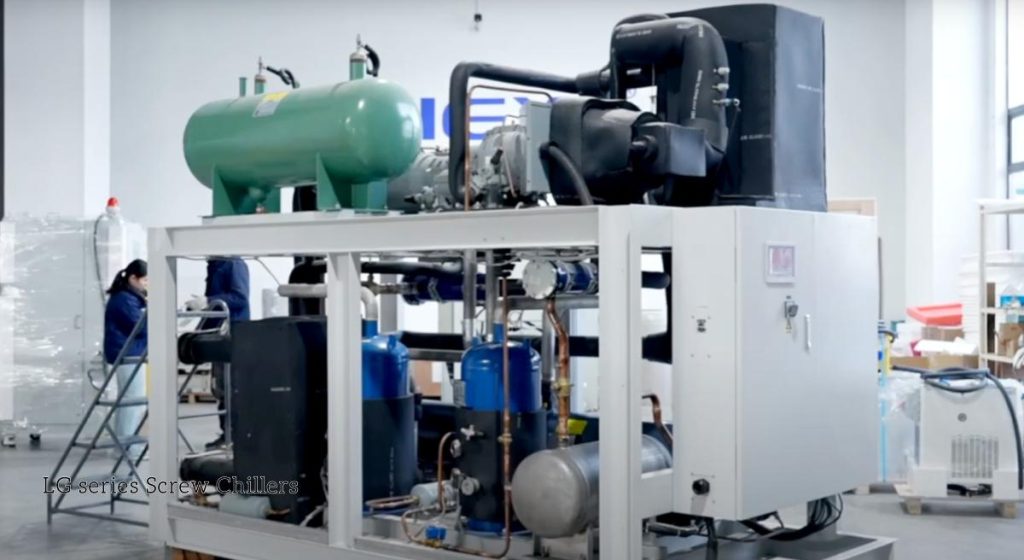
There are different compressor types and each behaves differently. Scroll compressors are common in small to medium units and they are quiet and simple. Screw compressors handle larger loads and partial load conditions with better efficiency. Centrifugal compressors are used for very large systems. Know the type and how it performs at part load.
Cooling method
Chillers come air cooled or water cooled. Air cooled units are easier to install and need less infrastructure. Water cooled units connect to a cooling tower and often run more efficiently especially in hot climates. The choice impacts maintenance, footprint, and long term energy cost.
Process pressure
Process pressure is the working pressure in your circulating loop. It must be compatible with your pumps and heat exchangers. High differential pressure can stress seals and fittings. Low pressure can lead to cavitation. Check the chiller spec against your entire system pressure profile.
Reservoir capacity
A larger reservoir dampens temperature swings and buys you time when loads spike. In batch operations that buffer helps a lot. Smaller tanks make the system snappier but less forgiving. Think about how often your load changes and pick capacity to smooth those swings.
Noise Level
Noise matters for people on site. A unit that is too loud will annoy operators and may violate local noise rules. Noise specs are usually given in decibels. Remember that sound levels add up in rooms with multiple machines. Consider acoustic treatments if the numbers are marginal.
Dimensions and Weight
Physical size affects installation. Check door widths, elevator capacities, and roof load limits before the unit ships. Weight also matters for rigging. An undersized lift or a tight corridor can turn into a project delay. You should always verify clearances early.
Conclusion
When you match specs to real site conditions you reduce downtime and save money. If you want we can help you determine the appropriate parameters for your chiller system based on your application, and customize a reliable system for you.

Recent Blogs
- Chiller Components and Refrigeration Fundamentals Guides
- Chiller Types and Selection Guides
- How Does a Peltier Cooler Work
- Peltier Chiller vs. Compressor Chiller
- What Is a Peltier Chiller
- OEM vs Aftermarket Chiller Spare Parts
- Chiller Surge
- Chiller Cooling Capacity Units
Catalog
- December 2025
- November 2025
- October 2025
- September 2025
- August 2025
- July 2025
- June 2025
- May 2025
- March 2025
- February 2025
- January 2025
- December 2024
- November 2024
- October 2024
- September 2024
- August 2024
- July 2024
- June 2024
- May 2024
- April 2024
- March 2024
- February 2024
- September 2023
- July 2023
- June 2023
- May 2023
- January 2023
Tag
air cooled chiller chiller Chiller Maintenance chillers Cold Assembly Freezer cooling chiller dynamic temperature control system energy efficient chiller heating circulator industrial chiller industrial chillers industrial cooling industrial freezer industrial refrigerator jacket reactor laboratory chiller low temperature chiller news process chiller process cooling reactor cooling reactor heating cooling refrigerated circulator screw chiller semiconductor chiller semiconductor test chiller sundi tcu temperature control test chamber thermostat ultra low temperature chiller vehicle test chiller water chiller water cooled chiller
Contact Us
Related Chillers

CONTACT US
TEL:
EMAIL:
WeChat & WhatsApp:

Wechat QR

Have a question or need a quote? Fill out the form below, and our team will get back to you within 24 hours.

