 LNEYA Industrial Chillers Manufacturer Supplier


Why Cleanrooms Need Chillers
Cleanrooms are unforgiving places. Everything inside them is built around stability. If the temperature drifts, if the humidity creeps up, if the air shifts out of spec, your process pays the price.
What keeps these rooms in check isn’t only the filters or the air showers at the door. Behind the walls, chillers are running nonstop. Without them, no cleanroom would stay “clean” for long.
What Is a Cleanroom
A cleanroom is just a space where the number of particles, the temperature, and the humidity are tightly controlled. You’ll find them in pharma plants, semiconductor fabs, biotech labs, and even in medical device assembly.
It’s not just walls and filters. You’ve got air handlers pumping constantly, pressure systems keeping the balance, filtration catching microscopic dust, chilled water loops running in the background, and monitoring systems that never take a break. Miss one beat, and the rest of the system starts struggling. That’s why chillers matter.

Why Cleanrooms Need Chillers
Controlling Temperature and Humidity
The lights, the equipment, even the people add heat load. In one electronics facility, the photolithography area would climb several degrees in under an hour without cooling. That small change caused misalignment during wafer processing.
If it’s too dry, static electricity can build up and damage sensitive chips. If it’s too humid, condensation will form on walls, pipes, and even product surfaces. Moisture can become a carrier for particle or microbial growth.
Chillers, combined with precision air handling units, ensure that temperature and humidity levels remain within extremely tight limits.
Preventing Contamination
Contamination isn’t always about dust or fibers floating in the air. A poorly controlled temperature can cause condensation on ceilings or equipment. We once toured a biotech site where droplets were forming on a stainless-steel tank jacket.
That moisture was clean water, but in a cleanroom, any liquid surface is a risk. Chillers reduce that risk by holding environmental conditions steady and preventing condensation from ever forming in the first place.

Maintaining Air Quality
The air handling unit is the heart of a cleanroom, but it can’t function without a reliable cooling backbone. Filters, fans, and pressure cascades all assume a stable thermal environment. If the cooling loop starts drifting, the entire HVAC system struggles, and suddenly your ISO classification is in question.
Protecting Sensitive Equipment
Cleanrooms are full of gear that doesn’t forgive mistakes. High-resolution microscopes, steppers, fermenters—they all demand a narrow operating band. One imaging tool in a medical lab refused to calibrate if the inlet cooling water was more than half a degree off. That’s how unforgiving the specs can be. A chiller isn’t just about comfort cooling; it’s insurance for the most expensive equipment in the room.
How Cleanroom Chillers Work
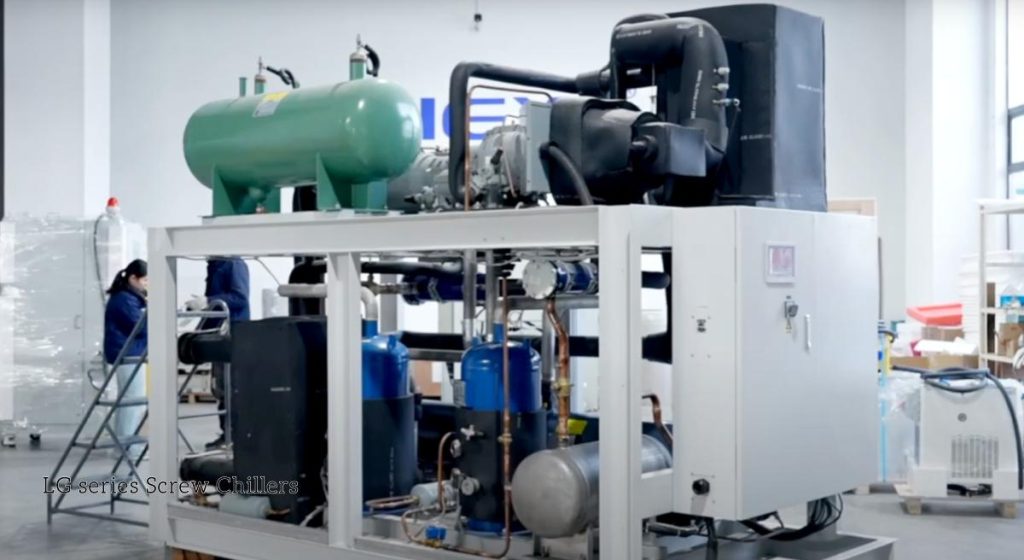
A chiller pulls heat from one loop and dumps it somewhere else. Warm process water flows into the evaporator, where refrigerant absorbs the heat. The compressor raises the refrigerant’s temperature and pressure. The condenser then rejects the heat outdoors or into another system.
Cleanroom chillers are built with extra safeguards. Dual compressors or circuits keep them running even if one side fails. Variable-speed drives help match cooling output to the actual load, saving energy while keeping conditions tight.
Some models are tuned to hold outlet water temperature within ±0.1°C—because in certain cleanrooms, that’s the difference between success and wasted product.
How to Choose the Right Chiller for a Cleanroom
There’s no one-size-fits-all. A pharma cleanroom doesn’t have the same needs as a semiconductor fab. Before you pick a system, you have to look at:
• Temperature and Precision: What’s the tolerance of your process? Some applications demand ±0.5°C, others much tighter.
• Load Profile: Is your demand steady, or does it spike during production cycles? Oversizing wastes energy; undersizing risks stability.
• Integration: Can the chiller tie smoothly into your AHUs and building management system?
• Reliability: If your process runs 24/7, you can’t gamble on a single point of failure. Redundancy matters.
• Efficiency: Power costs add up. Inverter-driven compressors, heat recovery, or free cooling options make a long-term difference.
Our chiller experts usually tell clients to think less about the biggest load and more about the most common load. A chiller that runs efficiently 90% of the time is worth more than one that’s oversized for rare peak days.
Conclusion
If your facility is struggling with temperature swings or humidity drift, don’t wait until it costs you a batch. The right chiller system can pay for itself in reliability alone.
Contact us today to discuss your temperature control needs and find the right chiller solution for your facility.

Recent Blogs
- Chiller Components and Refrigeration Fundamentals Guides
- Chiller Types and Selection Guides
- How Does a Peltier Cooler Work
- Peltier Chiller vs. Compressor Chiller
- What Is a Peltier Chiller
- OEM vs Aftermarket Chiller Spare Parts
- Chiller Surge
- Chiller Cooling Capacity Units
Catalog
- December 2025
- November 2025
- October 2025
- September 2025
- August 2025
- July 2025
- June 2025
- May 2025
- March 2025
- February 2025
- January 2025
- December 2024
- November 2024
- October 2024
- September 2024
- August 2024
- July 2024
- June 2024
- May 2024
- April 2024
- March 2024
- February 2024
- September 2023
- July 2023
- June 2023
- May 2023
- January 2023
Tag
air cooled chiller chiller Chiller Installation Chiller Maintenance chiller refrigerant chillers Cold Assembly Freezer cooling chiller cooling heating system cooling system dynamic temperature control system energy efficient chiller explosion-proof chiller freezer heating circulator industrial chiller industrial chillers industrial cooling industrial freezer industrial refrigerator jacket reactor laboratory chiller low temperature chiller news oil chiller process chiller process cooling reactor chiller reactor cooling reactor cooling heating reactor heating cooling refrigerated circulator screw chiller semiconductor chiller semiconductor test chiller sundi tcu temperature control test chamber thermostat ultra low temperature chiller vehicle test chiller water chiller water cooled chiller
Contact Us
Related Chillers

CONTACT US
TEL:
EMAIL:
WeChat & WhatsApp:

Wechat QR

Have a question or need a quote? Fill out the form below, and our team will get back to you within 24 hours.

