LNEYA Industrial Chillers Manufacturer Supplier


Heat sink temperature application note
Industry News NEWS 1661
As we all know, the semiconductor industry has certain characteristics, small size, high reliability, wide working range, and has a wide range of applications in the civilian, industrial and other fields of semiconductors, but with the increasing output power of semiconductors, its waste heat effect More and more prominent, the temperature of semiconductor devices is also getting higher and higher, resulting in lower and lower conversion efficiency, and the position of the lasing wave is shifted. The heat sink temperature control of Wuxi Guanya can control the temperature of the microchannel heat sink of the semiconductor device at different temperature ranges to control the temperature. The heat sink temperature control is suitable for the heat and heat release process control during the reaction process, and the temperature of the semiconductor device is accurately and linearly controlled. The program control mode can be selected, and the heat transfer medium and the temperature difference can also be set. The heat sink temperature control system adopts a fully closed cycle, which does not generate oil mist at high temperature, and does not absorb moisture at low temperature. There is an expansion tank in the system, and the heat transfer medium expands and contracts during cooling and heating.
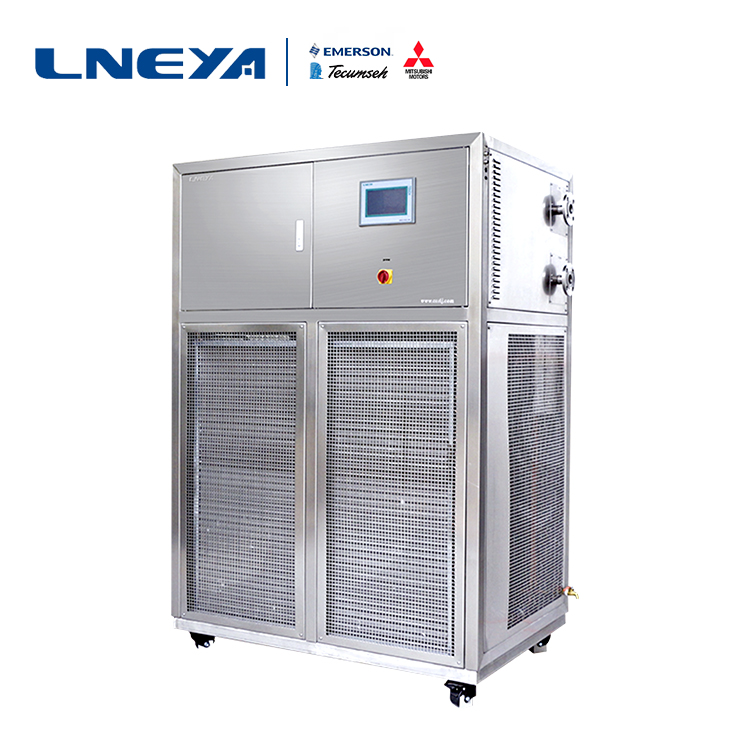
The heat sink temperature control adopts self-developed high-temperature resistant and low-temperature magnetic drive non-leakage pump to reduce the risk of leakage. At the same time, it has low noise, large flow, long lift, large flow rate, low heat generation and other advantages. At the same time, it adopts variable frequency motor, which can be controlled by frequency conversion according to user requirements, and is more suitable for overshooting reaction of short-term intense heat release and heat absorption. The temperature range of the heat sink temperature control uses Emerson’s electronic expansion valve to precisely control the number of steps of the stepper motor, thus precisely controlling the electronic expansion valve opening (percentage of opening), in order to accurately control the evaporation of the compressor refrigerant The purpose is to optimize the refrigeration state of the compressor, reduce the process fluctuation caused by the change of the refrigeration power of the compressor, and improve the control precision and control stability.
Heat sink temperature control has certain requirements in performance, so it is better to require heat sink temperature control manufacturers to have certain guarantees for performance and after-sales service.
Related recommendations
-
After Adding A Backwater to the Heater, Hot Water Will Come Out Anytime and Anywhere in Winter
1328The principle is also simple. A water pipe is added at the outlet of the hot water pipe to form a closed circuit. The recirculation pump is connected to the water heater. When the tap is turned on, the circulating pump automatically pumps the col...
View details -

When to choose TCU temperature control system?
1546First of all, we need to know that the reaction kettle generally needs to carry out the necessary temperature control along with the chemical reaction of the material itself. Through the temperature change of the circulating medium in the jacket ...
View details -
Refrigeration heating and temperature control system of chemical reaction kettle
1435The reaction kettle cooling and heating temperature control system plays a certain role in the temperature control of various materials of reaction kettle, and its temperature control effect affects the results of reaction experiment. The stable o...
View details -
The cooling circulation system is used to collect the non-condensable tail gas in the distillation s
1548Most rectification towers are two-stage condensation. The first stage uses cooling water, mainly condensing the top steam, and the second stage uses chilled water or ethylene glycol, which is mainly used to treat tail gas and remove a small amount...
View details